Tutorial
0. Getting Started
1. Account Creation and Initialization
2. Set up the domain and link with employee master data
3. Cost Management Setup
4. Integrating SaaS
5. Setup Billing
Inviting other users
What's New
SaaS Integration Guide
List of supported SaaS
1Password
AKASHI
AWS IAM Identity Center
Acall
Active! gate SS
ActiveCampaign
Adobe CC (Enterprise plan)
AirCourse
Airtable
Akerun
Amazon Business
Amazon Web Services (AWS)
Amplitude
Amptalk
Apollo
App Store Connect
AppFigures
Appfollow
AppsFlyer
Asana
Ashita_cloud
Atlassian
Autify
Autodesk(Suspended)
Awesome Screenshot
Backlog
BambooHR
Basecamp
Bigin by Zoho CRM
Bitbucket
Bitdefender
Bitrise
Bitwarden
Biz Storage fileshare
BlazeMeter
Board
Box
Brabio!
Businessmap
CLOMO
Cacoo
Calendly
Call Connect
Canny
Canva
Channel
ChatGPT for teams
Chatwork
CircleCI
Cisco Duo
Cisco Meraki
Cisco Umbrella
Claude.AI
ClickUp
Clip Studio
Clockify
Cloud CIRCUS
Cloud Campus
Cloud sign
CloudGate UNO
Cloudflare
Cloudflare Zero Trust
Codecov
CoderPad
Collaboflow
Confluence
Contentful
ContractS CLM
Convi.BASE
Coopel
Craft
Create! Web Flow
Crowdstrike
Cursor
Cybermail
Cybozu
Datadog
DatoCMS
DeepL
DeployGate
Dialpad
DirectCloud
Discord
DocSend
Docbase
Docker
DocuSign
Domo
Drata
Dropbox Business
Dropbox Sign
Dynatrace
Easy settlement
Elastic Cloud
Emergency Call
Envoy
Esa
Exment
Expensify
FastAnswer2
Fastly
Favro
Figma
FileForce
Fivetran
Float
Flyle
Fontworks
Formrun
Formspree
FreshBooks
Freshcaller
Freshchat
Freshdesk
Freshservice
Front
GMO Sign
Ganttpro
Garoon
Gather
Genesys Cloud
Ghost
GigaCC
Ginger
GitHub
GitKraken
GitLab
Google Ads
Google Cloud Platform
Google Drive with Service Account
Google Play Console
Google Tag Manager
Google Workspace
Grafana Cloud
GrooveHQ
HENNGE One
HERP Hire
HRBrain Talent Management
HRMOS Talent Management
HRMOS adopts
HRMOS diligence and indolence
HackMD
HaloPSA
Heap
Heroku
Honeybadger
Honeycomb
HotProfile
HubSpot
Hubble
Hubble (SCIM)
Huntress
ISM CloudOne
InVision
Intercom
Jamf
JetBrains
Jibble
Jicoo
Job Can Recruitment Management
Job Kan Attendance Management
Job Kan Labor HR
KARTE
KING OF TIME
Kamon
Kandji
Kaonavi
Keeper Enterprise
Kentik
Kibela
Kincone
Kintone (Japanese version)
Klipfolio
Kommo
LINE WORKS (OAuth linkage)
Lanscope Endpoint Manager
Lanscope Endpoint Manager (Device)
Lastpass
LaunchDarkly
Linear
Looker
Loom
Lucidchart
Lumin
Lychee Redmine
MAJOR FLOW Z
Mackerel
MagicPod
Mail Dealer
Mailtrap
Mailwise
Marketo Engage
Mekari Journal
Mekari Talenta
Meta Ads Manager
Metabase
MicroCMS
Microsoft 365
Microsoft Entra ID (Azure AD)
Microsoft Intune
Microsoft Teams
MiiTel
Miro
Money Forward Admina
Money Forward Cloud Accounting
Money Forward Cloud Accounting Plus
Money Forward Cloud Accounting Plus (Cost Data)
Money Forward Cloud Agreement
Money Forward Cloud Attendance
Money Forward Cloud Consolidated Accounting
Money Forward Cloud Expense
Money Forward Cloud Fixed Assets
Money Forward Cloud Human Resources Management
Money Forward Cloud Invoice
Money Forward Cloud My Number
Money Forward Cloud Payroll
Money Forward Cloud Social Insurance
Money Forward Cloud Year-End Tax Adjustment
Money Forward Cloud payable
Money Forward Pay for Business
Morisawa Fonts
Mural
My Redmine
NEXT ENGINE
NI Collabo 360
Netlify
Netsuite
New Relic
NinjaMock
NinjaOne RMM
NotePM
Notion
Okta
OneDrive
Onelogin
OpenAI Platform
Openlogi
OpsRamp
OutSystems
Overflow
PHONE APPLI PEOPLE
PagerDuty
Percy
Perdoo
Pipedrive
Pipefy
Postman
Productboard
ProtoPie
Quantive
Quay
Questetra
Quickbooks
Rakuro
Re:lation
Receptionist
Recruitment batch Kanrikun
Redash
Redis Cloud
Reftab
Ricoh Drive
Rollbar
SAKURA Cloud
SECURE DELIVER
Salesforce
Sansan
Save Point
Seculio
SecureNavi
SendGrid
Sentry
ServiceNow
Shopify
Signavio
Site24x7
Sketch
Slack
Slack Enterprise
Slido
Smaregi Time Card
SmartHR
Smartsheet
Snowflake
Snyk
Soliton OneGate
SonarCloud
Soracom
Splashtop Enterprise
Square
Studio
Sumareji
Sunsama
TOKIUM
TOYOKUMO Safety Confirmation Service 2
Tableau
Tailscale
Tally
Tareru Dokodemo Cabinet
Tayori
Teachme Biz
TeamGantt
TeamSpirit
TeamViewer
Teamwork
Techtouch
Terraform Cloud
TestRail
TimeCrowd
Todoist
Toggl track
TrackJS
Transifex
Trello
Trimble
Trust Login by GMO
Twilio
Typeform
Unipos
Unity
VAddy
Valimail
Vercel
Vimeo
Wantedly
Webex by CISCO
Webflow
Whimsical
Wistia
WithSecure
Wix
Wordpress
Wordpress self-host (API)
Workable
Workplace from Meta
Wrike
X-Point Cloud
Xero
YarakuZen
Yayoi My Portal
Yoom
YouCanBook.me
YouTrack
YouTrack Self-Hosted
ZAC
Zaico
Zapier
Zendesk
Zenhub
Zeplin
Zoho Analytics
Zoho Books
Zoho CRM
Zoho Desk
Zoho Expense
Zoho Inventory
Zoho People
Zoho Recruit
Zoho Shifts
Zoom
bakuraku series
dbt Cloud
desknet's NEO
direct
eeasy
fondesk
freee HR
freee Sales
freee accounting
freee sign (formerly NINJA SIGN)
hotjar
i-Reporter
invox
job can payroll
job can workflow
kickflow
kintone (global version)
learningBOX
monday.com
n8n
n8n Self-Hosted
oVice
oplus
raku raku sales
smartround
trocco
workhub
SaaS Management
Request an unsupported SaaS or feature to be added
2-3. [Custom App] Integrating SaaS with Google Sheets
Check SaaS license status
Custom Apps(Manual Integration)
How can I learn more about how to work with cloud services?
How to link cloud services managed by other business divisions and departments?
Integration Log Function
Need to stop the integrated service
Troubleshooting failed integrations
Account Management
About alert types
Account Provisioning (register a new SaaS account)
Export account data
What is Last Activity
Employee Off-Boarding
Alert Mute
Delete/deactivate an account in the Admina by Money Forward
Do you have a retired account left?
Manage former employee accounts (Employee offboarding)
Note on possible data loss when deleting a cloud service account
Slack Notification Settings
Shadow IT
How to setup Admina Browser Extension
Shadow IT Detection
The detail of Shadow IT detection
[Event Log] Check SaaS usage
Manage public files
External Shared Content Management Functions
[Google Drive] Specify the conditions for detecting files
[Safelist] Exclude detected files
Device Management
Device features FAQ
How to create a device ledger CSV for import
List of management items
Use device functions
Cost Management
Use cost management β
Check the payment status of SaaS
Cost Management with CSV Data
Manage SaaS contract dates
Manage SaaS invoices and receipts
Billing
How to Setup SAML
How to setup SCIM
How to setup SCIM (Okta Integration Network)
Integration procedures when 2FA (two-factor authentication) is enabled
New Admina Role
To change your Money Forward Admina billing address
FAQ
Can I use two-factor authentication (2FA) to log into Money Forward Admina?
Deleted users in Google Analytics remain in Money Forward Admina
How to get an account with Jira, Confluence, Trello, etc.
How to invite Admina operators
I want to change my Money Forward Admina login password
If you link with the Money Forward Cloud Series, you will receive a security notification email
User name display (acquisition criteria)
What happens if the person who linked the cloud service retires?
What if IP address restrictions are applied on the SaaS side?
[Integration Error] Authentication error occurs when login using Google Authentication or SSO.
Others
Table of Contents
- Usage
- Prerequisites
- Create a new custom app and link a Google Sheet
- Link a Google Sheet to an existing custom app
- Re-linking Google Sheets
- Syncing with Google Sheets
- FAQ
- Q. Are there any settings required for Google Sheets other than File > Share > "Share with others"?
- Q. Are there any templates for Google Sheets?
- Q. Can I update via API?
- Q. Can I manage multiple sheets within a single Google Sheets file? Is this supported?
- Q. Can I register multiple licenses or roles in the custom app/spreadsheet integration?
- Q. Is there a way to import only rows that meet specific conditions in Google Sheets?
- All Categories
- SaaS Management
- 2-3. [Custom App] Integrating SaaS with Google Sheets
2-3. [Custom App] Integrating SaaS with Google Sheets
 Updated
by Yamaguchi Kaori
Updated
by Yamaguchi Kaori
- Usage
- Prerequisites
- Create a new custom app and link a Google Sheet
- Link a Google Sheet to an existing custom app
- Re-linking Google Sheets
- Syncing with Google Sheets
- FAQ
- Q. Are there any settings required for Google Sheets other than File > Share > "Share with others"?
- Q. Are there any templates for Google Sheets?
- Q. Can I update via API?
- Q. Can I manage multiple sheets within a single Google Sheets file? Is this supported?
- Q. Can I register multiple licenses or roles in the custom app/spreadsheet integration?
- Q. Is there a way to import only rows that meet specific conditions in Google Sheets?
This guide explains how to manage and sync SaaS accounts with custom apps using Google Sheets. In addition to manual entry or CSV imports, you can now manage and sync SaaS accounts directly via Google Sheets.
Usage
- Prerequisites
Google Sheets and data preparation
Sharing access permissions - Linking Google Sheets
Create a new custom app and link a Google Sheet
Link a Google Sheet to an existing custom app
Re-link a Google Sheet - Running Sync
Sync with Google Sheets
Prerequisites
To link Google Sheets, please perform the following preparation steps.
Google Sheets and Data Preparation
First, prepare the format of your Google Sheet.
Header Row (Required) | Please ensure that the first row of the sheet contains headers. The AI will use these headers as a reference for automatic mapping. |
Flexible Formatting | You may use data exported directly from your SaaS. The AI will identify items based on the headers. |
Setting Up Sharing and Access Permissions
To allow the system to access your Google Sheet, add the dedicated account to the shared members.
- Click File in the top-left corner of the Google Sheet > Share > "Share with others".
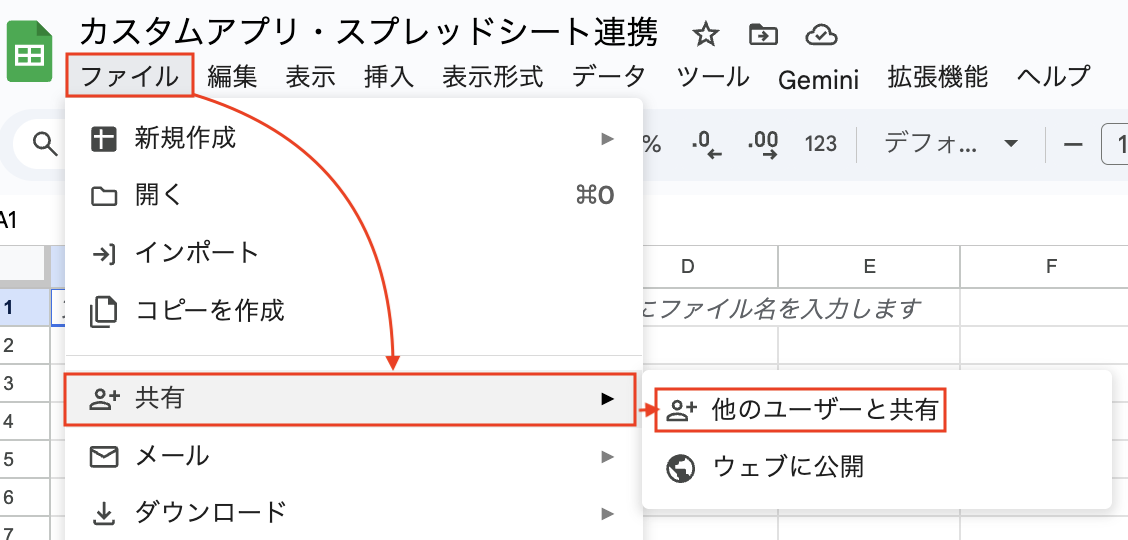
- Paste
prod-sheets-reader@money-forward-itmc.iam.gserviceaccount.cominto the "Add people and groups" field and click [Send].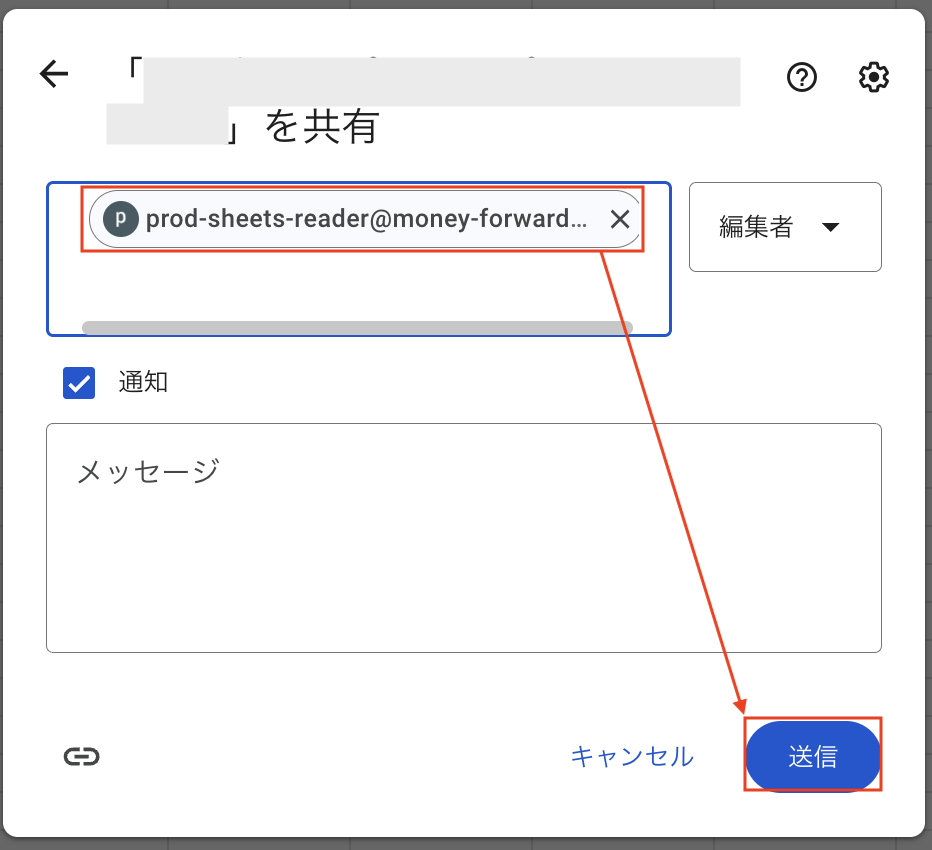
- When "Share with people?" appears, click [Share anyway].
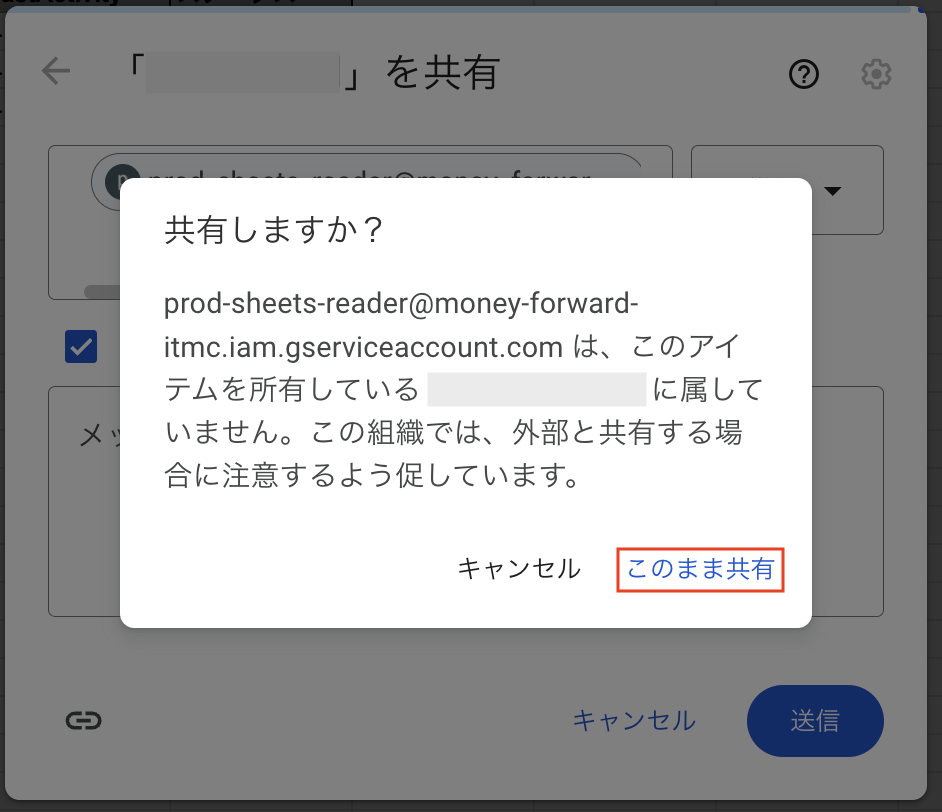
Create a new custom app and link a Google Sheet
- In Integrations > Integrations, click [Register and manage services without integration].

- On the "Register and manage services without integration" screen, configure the following items and click [Create].
Search for a service:Search for and select a service, or enter a custom service name.
Workspace name:Enter a preferred workspace name.
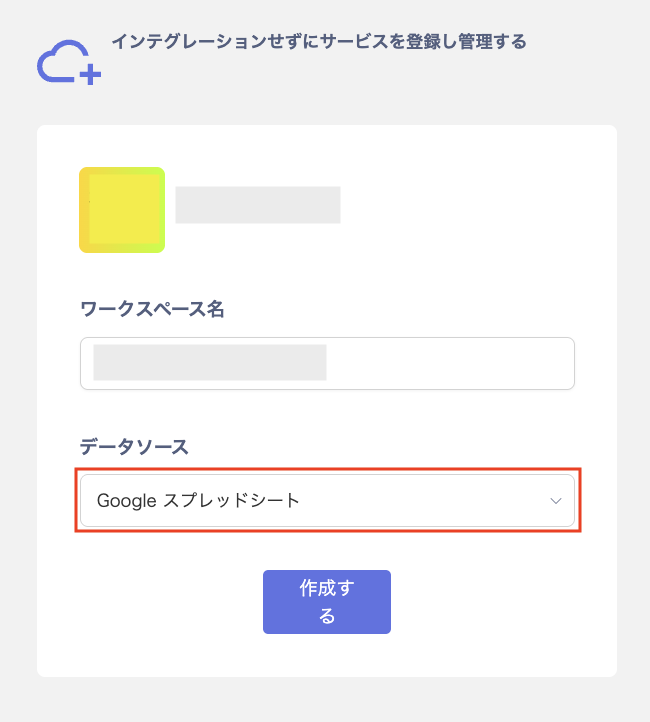
Data source:Select "Google Sheets".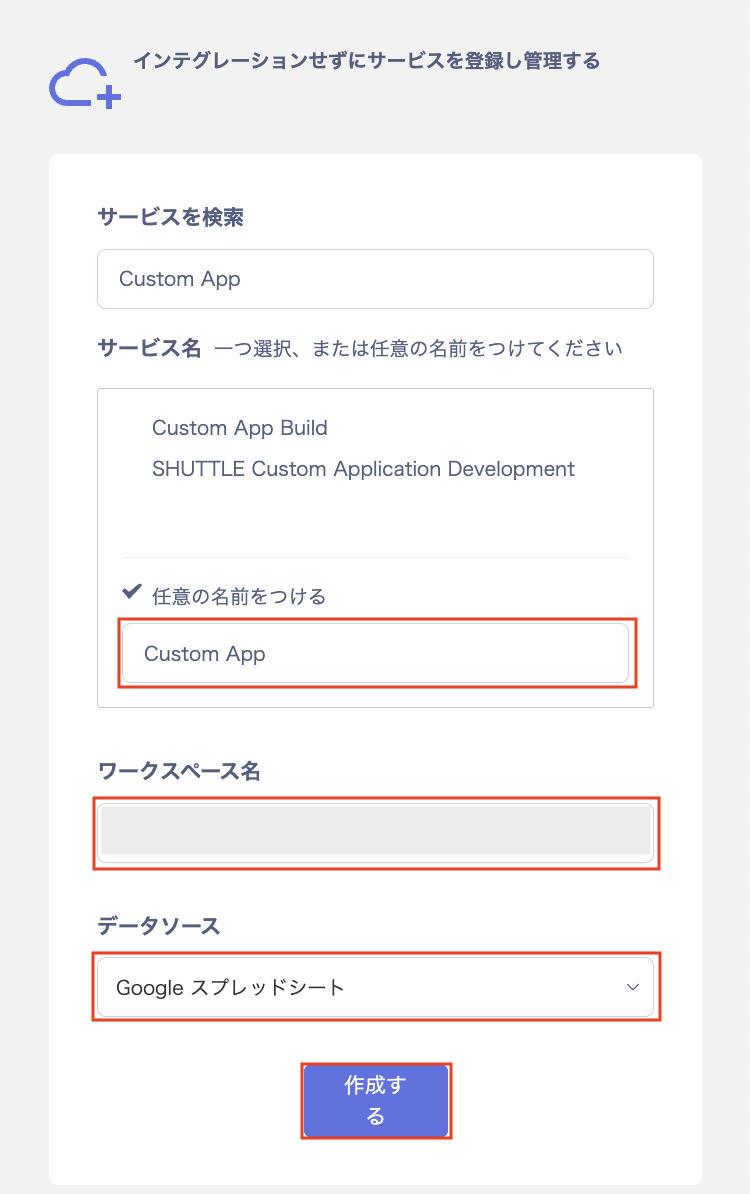
- On the "Specify Google Sheets file" screen, enter the "Google Sheets file URL" and click [Start Integration].
Paste the URL of the Google Sheet you prepared into the "Google Sheets file URL" field.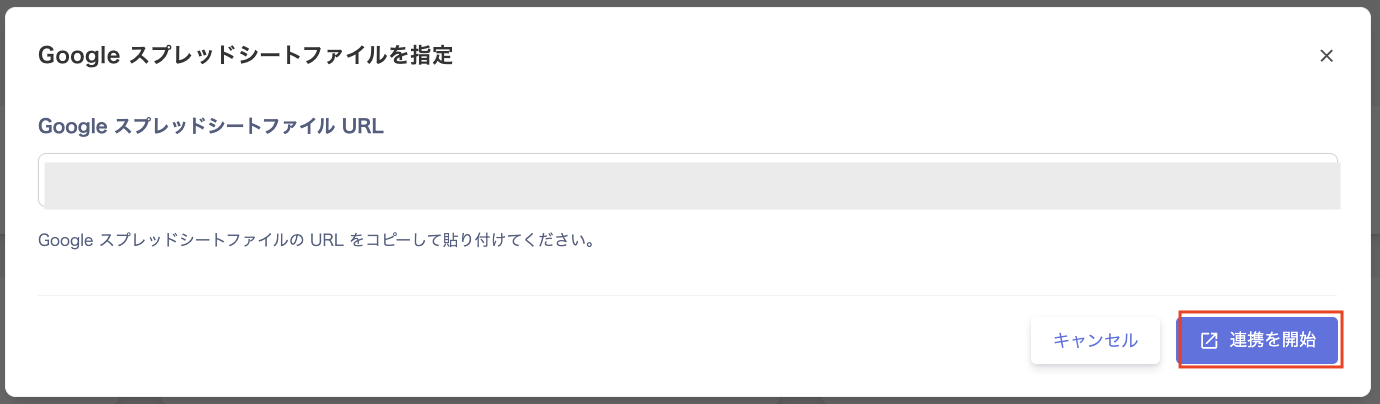
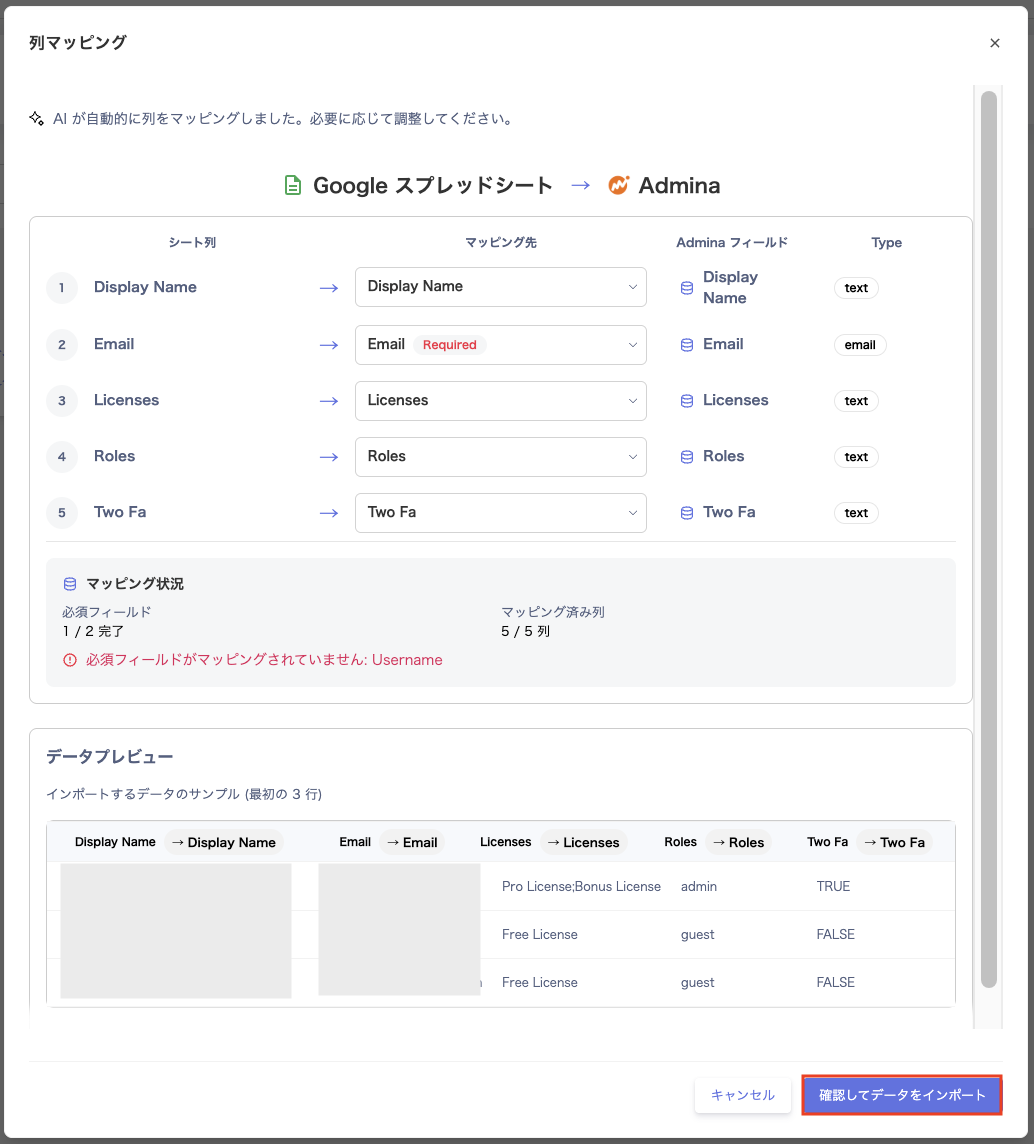
- On the "Column Mapping" screen, check the "Mapping Destination" and "Data Preview," then click [Confirm and Import Data].On the "Column Mapping" screen, the AI will automatically set the "Mapping Destination." Please change it if necessary. You can map to "Saas User Id/Display Name/Roles/Licenses/Username/Email/Status/Two FaLast/Activity/Do not map." Please set columns you do not want to import into Admina to "Do not map."
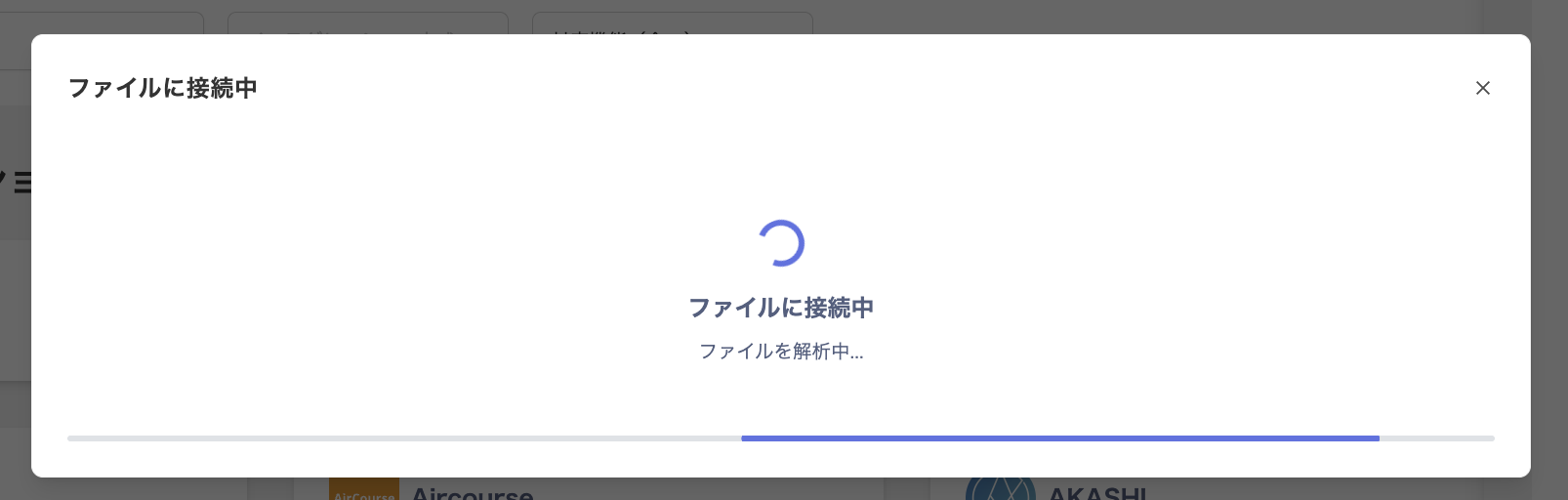
- The "Connecting to file" screen will appear.
- The "Integration Complete" screen will be displayed, so click [Finish].
You can view the linked custom app on the Services screen.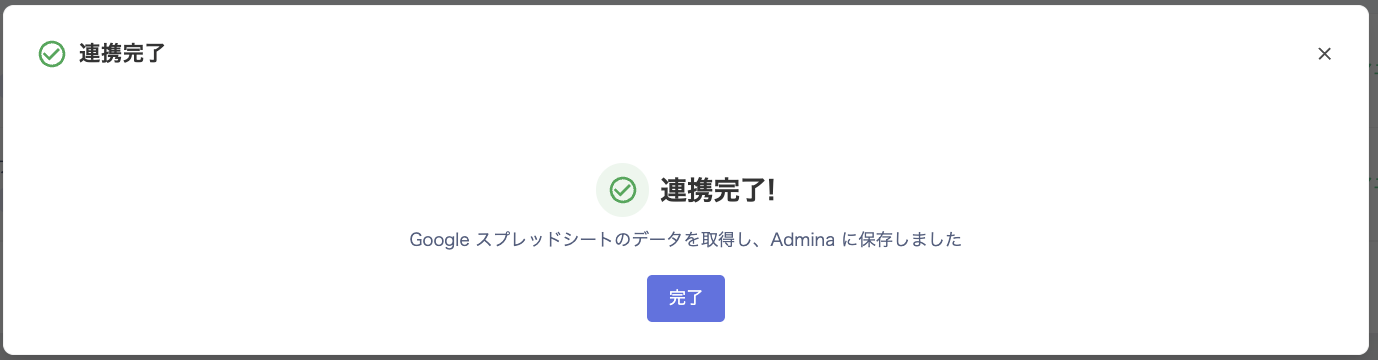
Link a Google Sheet to an existing custom app
- Go to Services > Custom App > Information and click [+New Integration].

- Enter a workspace name, select "Google Sheets" as the data source, and click [Create].
- On the "Specify Google Sheets file" screen, enter the "Google Sheets file URL" and click [Start Integration].
Paste the URL of the Google Sheet you prepared into the "Google Sheets file URL" field. - On the "Column Mapping" screen, check the "Mapping Destination" and "Data Preview," then click [Confirm and Import Data].On the "Column Mapping" screen, the AI will automatically set the "Mapping Destination." Please change it if necessary. You can select the following for Mapping Destination: "Saas User Id/Display Name/Roles/Licenses/Username/Email/Status/Two FaLast/Activity/Do not map." Please set columns you do not want to import into Admina to "Do not map."
- The "Connecting to file" screen will be displayed.
- The "Integration Complete" screen will be displayed, so click [Finish].
You can view the linked custom app on the Services screen.
Re-linking Google Sheets
If you need to change the mapping, click the three-dot menu[︙]to the right of the workspace under Information and select [Re-link].
After clicking [Re-link], please refer to step ③ and onwards in the "Link a Google Sheet" section.

Syncing with Google Sheets
If you update the Google Sheet, the account information in the custom app will be updated via automatic or manual synchronization.
- Automatic Sync:Account information is updated during the nightly automatic sync.
- Manual Sync:Please refer to the "Execute Sync" section for how to perform a manual sync.
FAQ
Q. Are there any settings required for Google Sheets other than File > Share > "Share with others"?
A. No other settings are required besides adding prod-sheets-reader@money-forward-itmc.iam.gserviceaccount.com to "Share with others."
There are no requirements regarding the type of access permissions (Editor/Viewer) or the file location (Shared Drive/My Drive).
Q. Are there any templates for Google Sheets?
A. We recommend any format, so there are no specific templates; however, you can use the bulk registration template for accounts.
Q. Can I update via API?
A. API updates are not supported.
Q. Can I manage multiple sheets within a single Google Sheets file? Is this supported?
A. Yes, it is supported. Since the URL displayed in the browser differs for each sheet, please copy and paste the URL for the specific sheet you wish to link.
Q. Can I register multiple licenses or roles in the custom app/spreadsheet integration?
A. Yes. Enter the values in the "licenses" and "roles" columns of your Google Sheet, separated by commas. After syncing with the Google Sheet, you can verify that multiple entries are registered in the custom app.
Example:To register three licenses "L1, L2, L3" under "licenses," enter "L1,L2,L3."
To register two roles "R1, R2" under "roles," enter "R1,R2."
Q. Is there a way to import only rows that meet specific conditions in Google Sheets?
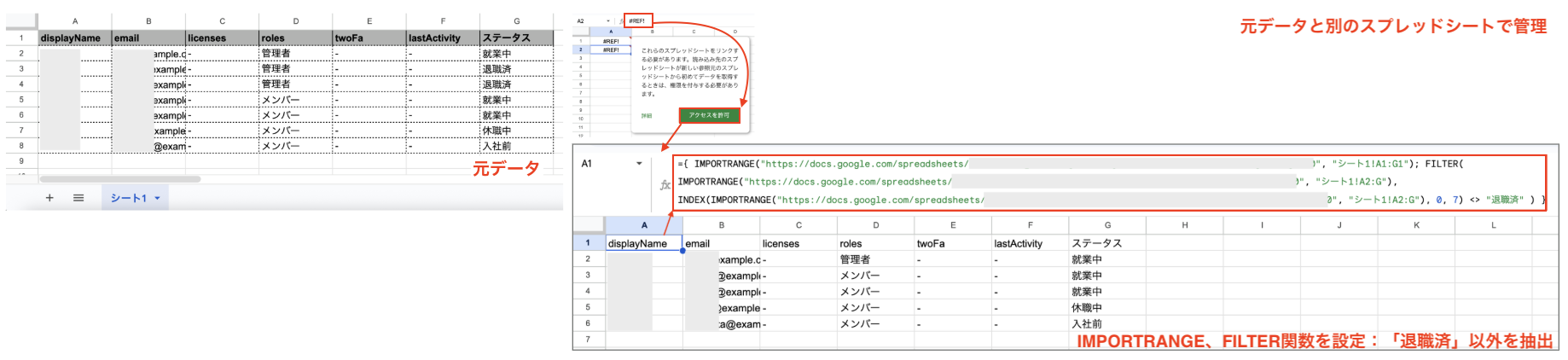
A. Yes, you can use the FILTER function in Google Sheets to extract only the data that meets your conditions without editing the original source data.
Please refer to the configuration examples below and set your formulas accordingly.
Extraction Patterns | Formula used | Meaning of operators | Remarks |
Extracting specific items only (e.g., "Active" only) Extracting |
| = ( Equal to ) | Displays rows where column G matches the specified text. |
items excluding specific ones (e.g., excluding "Retired") |
| <> (Not equal to) | Displays rows where column G does not match the specified text. |
Extracting from a separate file while maintaining headers (e.g., excluding "Retired") |
| <> (Not equal to) | Displays rows where column G is not "Retired". Pins the header in row 1. |
Example:If you want to automatically display only the rows marked as "Active" in "Sheet 2" from the source data pasted into "Sheet 1"
Set the headers in the first row of "Sheet 2," and input the FILTER function into cell A2 of "Sheet 2" to extract the "Active" rows. When integrating, set the "Google Sheets file URL" to the URL of "Sheet 2."

Example:If you want to automatically display data in "Sheet 2" from source data pasted into "Sheet 1," excluding rows marked as "Retired"
Set the FILTER function in cell A1 of "Sheet 2" to extract all rows except for "Retired." (Headers are required.)
When integrating, set the "Google Sheets file URL" to the URL of "Sheet 2."

Example:If you want to automatically display data in "Sheet 1" of an integration spreadsheet from source data in a management spreadsheet, excluding rows marked as "Retired"
Set the function in cell A1 of "Sheet 1" in the integration spreadsheet to extract all rows except for "Retired." (Headers are required.)
When integrating, set the "Google Sheets file URL" to the URL of "Sheet 1" of the integration spreadsheet.